Fertility Basics
Amatoritsero Olumami-Oyibo ·
10 min read
FERTILITY EDUCATION
Medical information, not personal medical advice This guide explains common terminology and what fertility assessment may involve. It cannot diagnose the cause of a delay in conception. Seek advice from a your fertility clinician who can consider your age, history, test results and personal circumstances. |
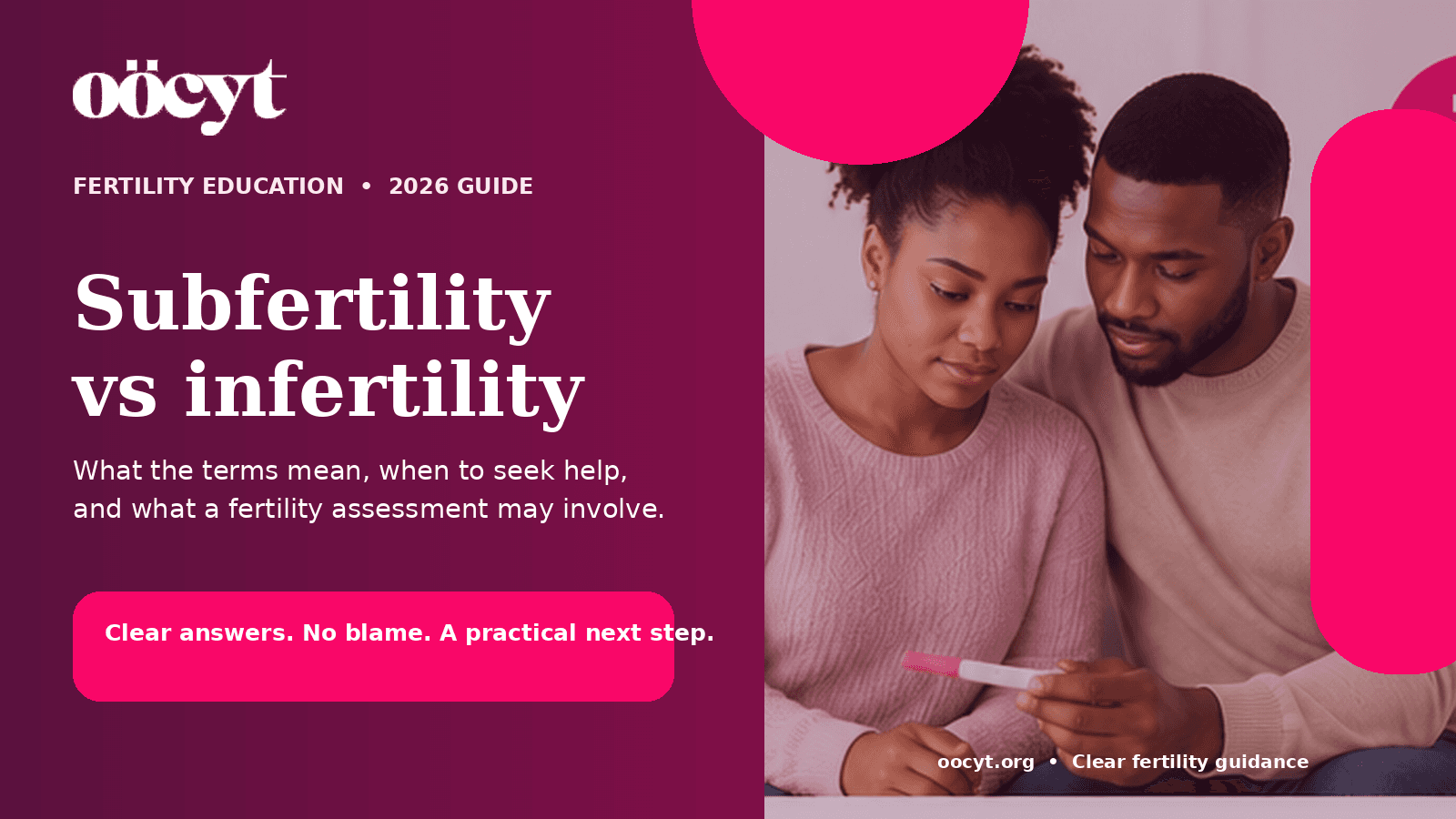
What is the difference between subfertility and infertility?
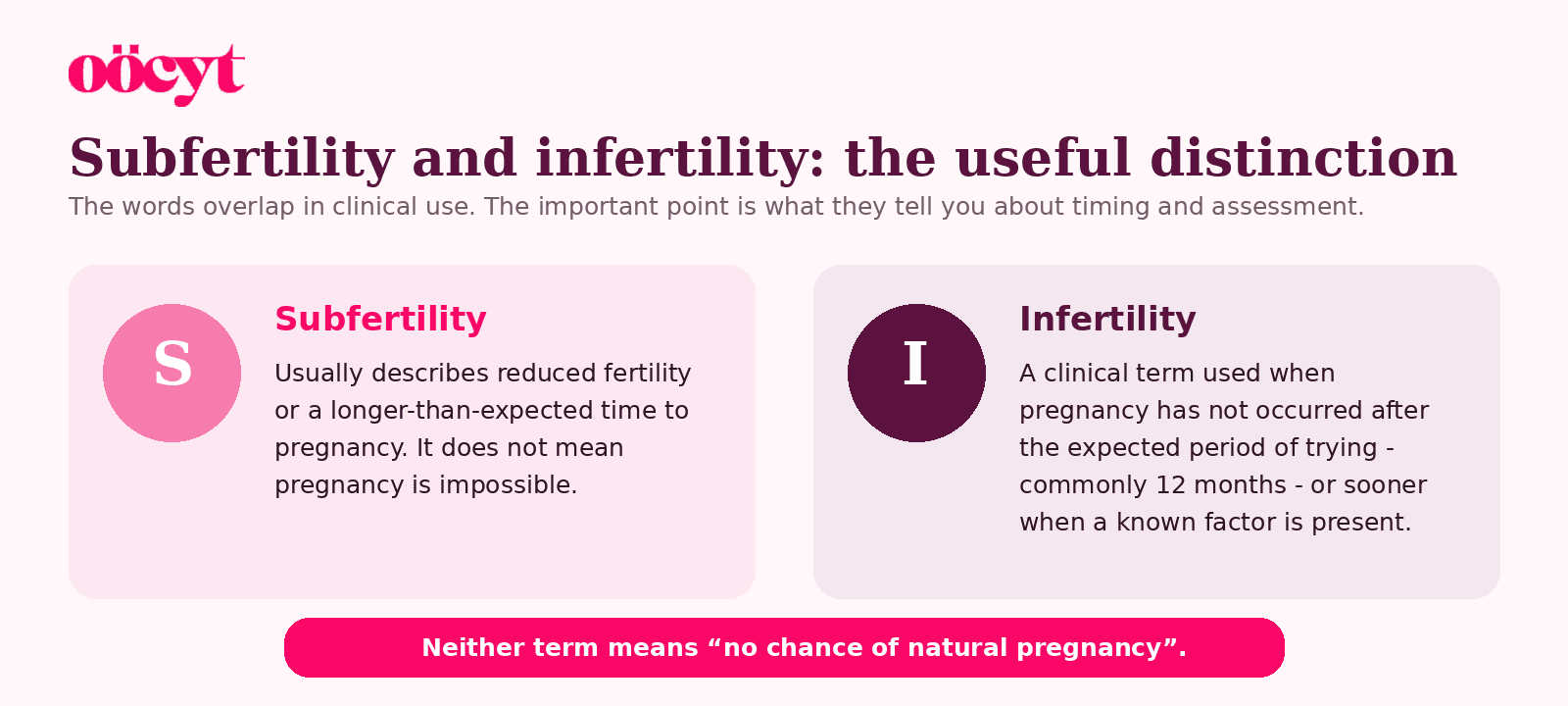
The simplest answer is that the terms overlap more than we know it. Subfertility usually describes reduced fertility or a longer-than-expected time to pregnancy. Infertility is the clinical term used when pregnancy has not occurred after a defined period of trying, commonly 12 months of regular unprotected sexual intercourse. [1,5]
Neither term means that pregnancy is impossible. Some people who meet the clinical definition of infertility later conceive without treatment, while others need medical support. The label alone does not tell you the cause, the chance of natural conception or which treatment, if any, is appropriate.
Oocyt clinical insight The useful question is not “Which label applies to me?” It is: “What may be delaying pregnancy, and what should we assess next?” |
At a glance
Subfertility | Reduced fertility or a delay in conception. Natural pregnancy may still occur. |
Infertility | A clinical definition based on time trying or a known condition affecting reproductive function. |
Common time point | Twelve months of regular unprotected intercourse for many people. |
Earlier assessment | Usually appropriate at age 36 or over, or when a known fertility factor is present. [2,3] |
Does infertility mean sterile? | No. Infertility does not mean there is zero possibility of natural conception. |
Who should be assessed? | Everyone contributing eggs, sperm or reproductive health to the attempt to conceive should be considered. |
Why the terminology can be confusing
There is no universally consistent dividing line between subfertility and infertility. Some professional and academic sources use the words as synonyms. Others use subfertility to emphasise that fertility is reduced rather than absent. [5]
The World Health Organization defines infertility as a disease of the male or female reproductive system characterised by failure to achieve pregnancy after 12 months or more of regular unprotected sexual intercourse. NICE uses the time spent trying to conceive as the point at which formal investigation and possible treatment become justified. [1,2]
A correction to a common myth Infertility does not automatically mean that medical intervention is required, and subfertility does not guarantee that pregnancy will happen naturally. The next step depends on the cause, age, duration of trying and individual priorities. |
Primary and secondary infertility
Primary infertility means that a person or couple has not previously achieved a pregnancy. Secondary infertility describes difficulty conceiving after a previous pregnancy, whether or not that pregnancy resulted in a live birth.
Secondary infertility can be just as distressing and clinically important as primary infertility. A previous pregnancy does not rule out a new ovulation problem, tubal damage, age-related change, a sperm factor or another condition.
How common are fertility difficulties?
The WHO estimates that around 1 in 6 adults experience infertility during their lifetime. Fertility problems can affect any sex, relationship type or family-building pathway, and the cause may involve one person, both partners or remain unexplained after standard testing. [1]
What can cause a delay in conception?
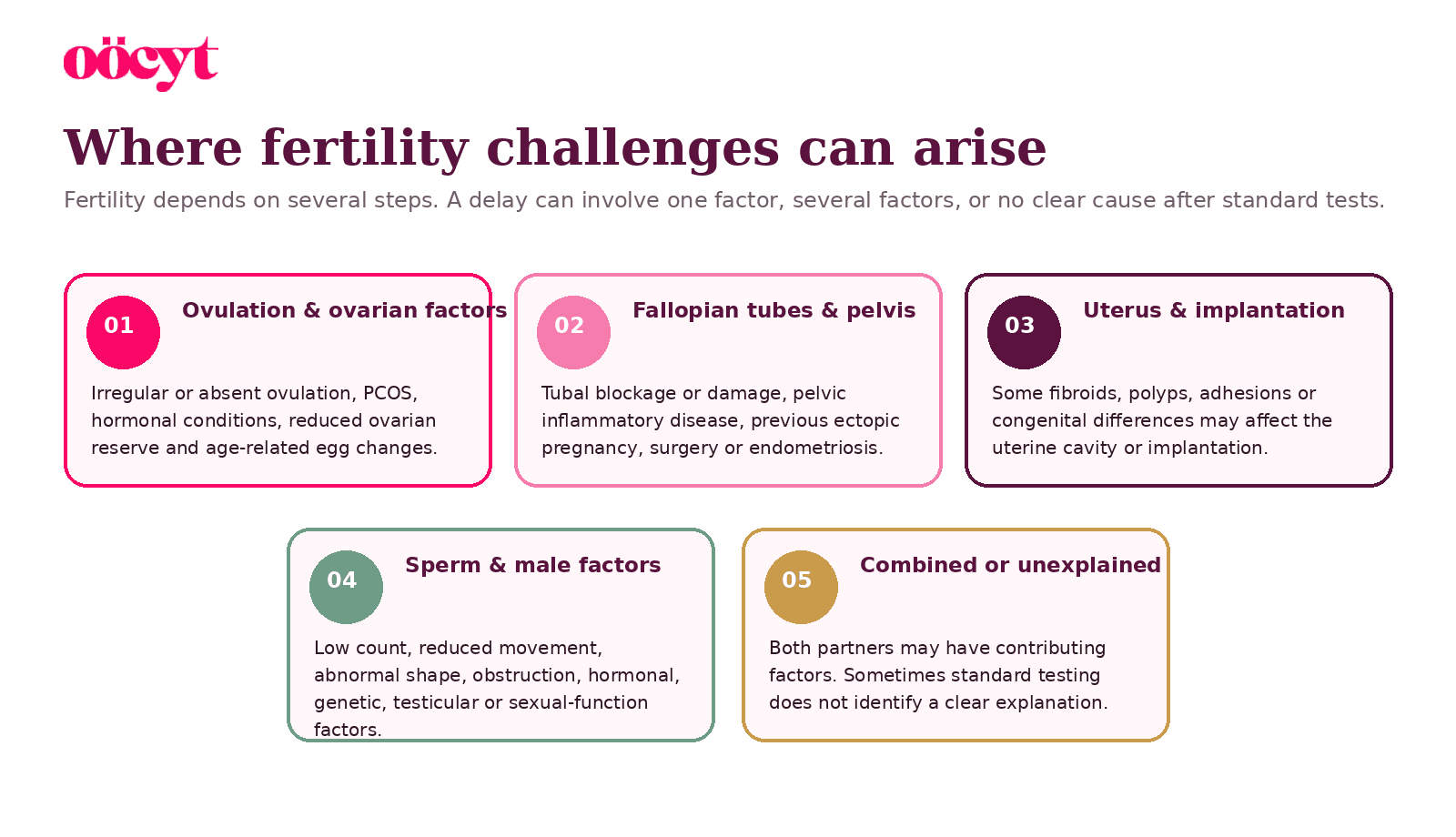
Pregnancy depends on a sequence of events: ovulation, healthy sperm reaching the egg, fertilisation, embryo development, transport through the fallopian tube and implantation in the uterus. A difficulty at any stage can lengthen the time to pregnancy.
Ovulation and ovarian factors
Irregular or absent ovulation is a common reason for difficulty conceiving. Possible causes include PCOS, thyroid or prolactin disorders, changes in body weight, intense exercise, perimenopause and other hormonal conditions. Reduced ovarian reserve and age-related egg changes may affect the chance of pregnancy even when periods remain regular.
Fallopian tubes, endometriosis and pelvic factors
Blocked or damaged fallopian tubes can prevent sperm and egg from meeting. Tubal damage may follow pelvic inflammatory disease, an untreated sexually transmitted infection, previous ectopic pregnancy, abdominal or pelvic surgery, or endometriosis. Endometriosis can also affect fertility through inflammation, scarring and changes in pelvic anatomy.
Uterine factors
Some conditions affecting the uterus can make conception or implantation more difficult. These include endometrial polyps, scar tissue inside the uterus, congenital differences in uterine shape and certain fibroids.
Not every fibroid affects fertility The location and size matter. Fibroids that distort the uterine cavity are more likely to be relevant than small fibroids that sit within or outside the muscle. Treatment is individualised; medication may manage symptoms, while surgery is considered selectively rather than automatically. |
Sperm and male fertility factors
Male factors can involve sperm production, sperm delivery or sexual function. Semen analysis looks at sperm concentration, movement and shape, but one result does not always provide a final diagnosis.
Previous testicular injury, undescended testes, torsion, infection or surgery.
Varicocele, hormonal conditions or genetic differences.
Obstruction of the reproductive tract, including congenital absence of the vas deferens associated with some CFTR variants.
Cancer treatment, some medicines, anabolic steroids or testosterone use.
Erectile or ejaculatory difficulties and some long-term health conditions.
Combined and unexplained infertility
Sometimes both partners have factors that reduce the chance of conception. In other cases, ovulation, tubal tests and semen analysis appear reassuring but pregnancy has still not occurred. This is called unexplained infertility. It is a diagnosis of exclusion, not proof that nothing is wrong.
Health and life factors: what matters without blame
Health behaviours can influence reproductive health, but they should be discussed without suggesting that someone caused their fertility problem. Biological age is particularly important for egg number and egg quality, while male reproductive ageing is usually more gradual.
  | Factors worth discussing with your clinician
|
What about stress?
Fertility difficulties can cause intense stress, grief and uncertainty. Stress may affect sleep, relationships and how often people have sex, but feeling stressed does not mean you caused infertility. Support should reduce pressure, not add another task to perform perfectly.
When should you seek fertility advice?
Many people conceive within the first year of regular unprotected sex, so a 12-month time point is commonly used for initial assessment. However, waiting a full year is not appropriate for everyone. [2,3,4]

Ask for earlier advice if you have:
Irregular or absent periods, or signs that ovulation may not be occurring.
A known diagnosis such as endometriosis, PCOS, chronic pelvic inflammatory disease or a history of ectopic pregnancy.
Previous pelvic, ovarian or testicular surgery, undescended testes or significant testicular symptoms.
A history of chemotherapy, radiotherapy or another treatment that may affect fertility.
A known sperm concern, sexual-function difficulty or inability to have regular vaginal intercourse.
Concerns about fertility preservation, donor conception or a family-building route that does not involve regular unprotected intercourse.
Do not wait for a label You do not have to prove that you are “infertile enough” before asking questions. A GP, fertility nurse or specialist can advise whether testing now is appropriate. |
How are fertility problems assessed?
A good fertility assessment looks at the whole pathway and, where relevant, evaluates both partners in parallel. Tests should be selected according to the history rather than ordered as a generic package for everyone. [2,4,6]
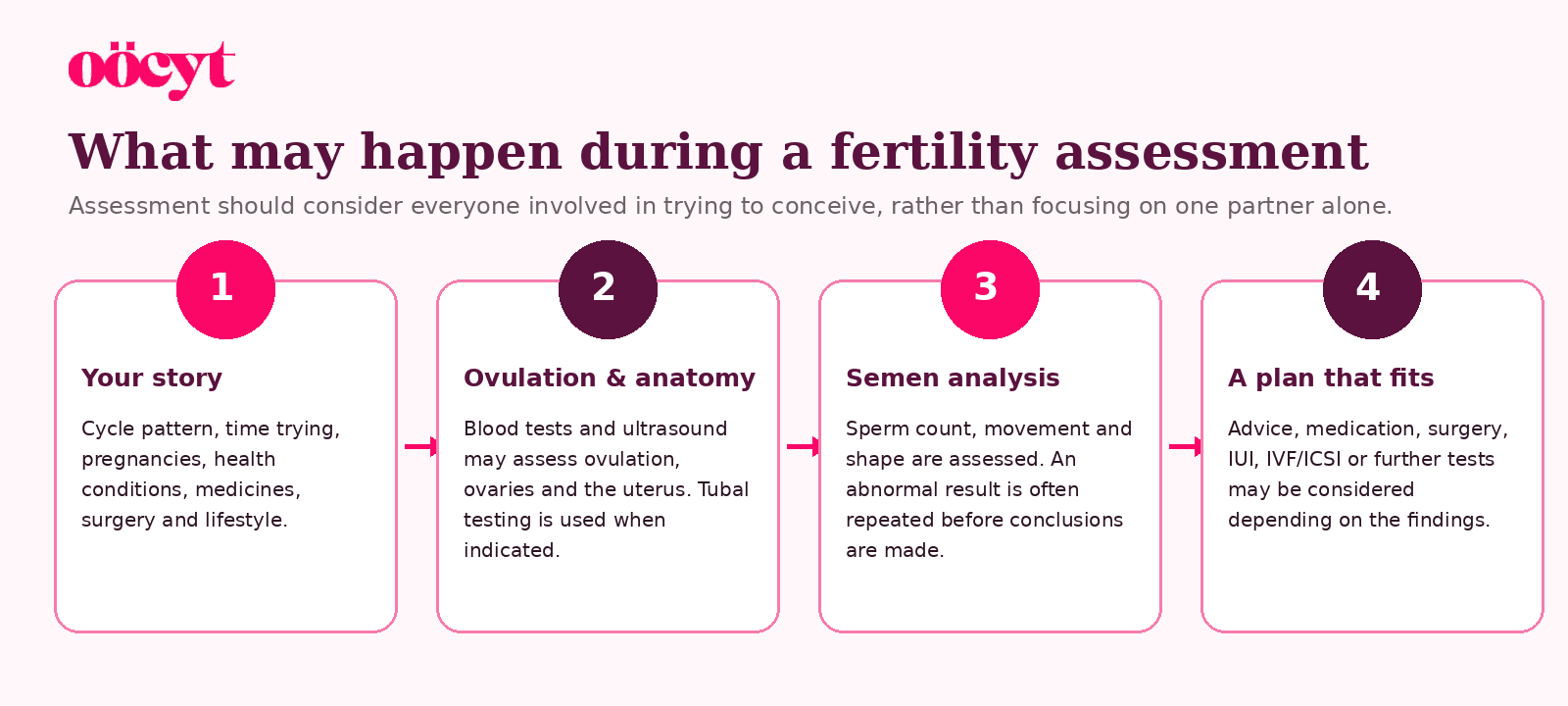
Tests for the person providing eggs or carrying the pregnancy
Menstrual, pregnancy, medical, surgical and sexual-health history.
Blood tests to assess ovulation or specific hormonal concerns when indicated.
Pelvic ultrasound to assess the ovaries, uterus and endometrial lining.
Assessment of fallopian-tube patency when clinically appropriate.
Additional tests guided by symptoms, previous results and the intended treatment.
Semen analysis
Semen analysis usually measures volume, sperm concentration, motility and morphology. Results vary naturally, so an abnormal result may need to be repeated. If a significant abnormality is confirmed, further hormonal, genetic, imaging or specialist tests may be recommended.
What happens after the assessment?
The next step depends on the cause and your priorities. It may include:
|  |
Emotional wellbeing matters
Difficulty conceiving can affect identity, confidence, relationships, sex, work and finances. People may feel grief, anger, envy, shame, anxiety or numbness. These reactions are understandable and do not mean you are coping badly.
Support may come from a partner, friend, counsellor, fertility support group, faith community or specialist service. It is also reasonable to set boundaries around pregnancy announcements, social events and conversations that feel overwhelming.
Oocyt support Oocyt can help you understand fertility terminology, prepare questions for a consultation, compare appropriate clinics and plan treatment locally or internationally. We provide education and navigation, while diagnosis and medical treatment remain with licensed clinicians. |
Frequently asked questions
Is subfertility less serious than infertility?
Not necessarily. Subfertility may sound less final, but the terms overlap. The clinical importance depends on age, the cause, how long you have been trying and your personal circumstances.
Can you conceive naturally after an infertility diagnosis?
Yes. Infertility is a time-based clinical definition, not the same as permanent sterility. The likelihood of natural conception varies widely depending on the cause.
Does infertility always require IVF?
No. Some people need no treatment, while others benefit from lifestyle or preconception advice, medication, surgery, IUI, IVF, ICSI or donor treatment. The cause should guide the plan.
Can fertility problems come from either partner?
Yes. Factors affecting eggs, ovulation, the uterus, tubes, sperm, sexual function or a combination can contribute. Assessment should avoid assuming that the problem sits with one person.
Can fibroids cause infertility?
Some fibroids can affect fertility, particularly when they distort the uterine cavity. Many fibroids do not prevent pregnancy and do not need fertility-directed treatment.
What if all tests are normal?
You may be given a diagnosis of unexplained infertility. This means standard tests have not identified a cause; it does not mean symptoms are imagined or that pregnancy is guaranteed.
When should I speak to someone?
Usually after 12 months of trying if under 36, sooner from age 36, and promptly at any age when there is a known fertility concern. [2,3]
The bottom line
Subfertility and infertility are not opposites Subfertility often describes reduced fertility; infertility is the clinical term used when assessment is justified. Neither tells you, on its own, whether pregnancy will happen naturally or which treatment is right. A complete assessment and a personalised plan matter more than the label. |
Ready for clearer next steps?
Oocyt helps you understand your options, compare clinics and prepare for fertility care with clearer information and realistic expectations. Visit oocyt.org
References
1. World Health Organization (2025). Infertility: fact sheet. View source
2. NICE (2026). Fertility problems: assessment and treatment. NICE guideline NG257. View source
3. NHS (accessed July 2026). Diagnosis of infertility. View source
4. American Society for Reproductive Medicine (2021). Fertility evaluation of infertile women: a committee opinion. View source
5. Gnoth, C. et al. (2005). Definition and prevalence of subfertility and infertility. Human Reproduction, 20(5), 1144-1147. View source
6. American Urological Association and American Society for Reproductive Medicine (2020). Diagnosis and treatment of infertility in men: guideline. View source
7. World Health Organization (2025). Guideline for the prevention, diagnosis and treatment of infertility. View source
Editorial disclaimer Oocyt provides fertility education, guidance and support services only. We do not provide medical advice, diagnosis or treatment. Medical decisions should be made with licensed healthcare professionals and your treating clinic. |