Treatment Journeys
Amatoritsero Olumami-Oyibo ·
4 min read

Medical information, not personal medical advice Letrozole should only be used under the direction of a qualified fertility clinician. Your age, diagnosis, ovarian response, sperm results, tubal health and treatment setting all affect your individual chance of success. |
|---|
How to interpret letrozole statistics
The mistakes that turn useful evidence into misleading promises
Fertility statistics are emotionally powerful. A high number can create false certainty, while a low number can remove hope too quickly. The number itself is only useful when you understand who was studied, what outcome was measured and how closely the study resembles your situation.
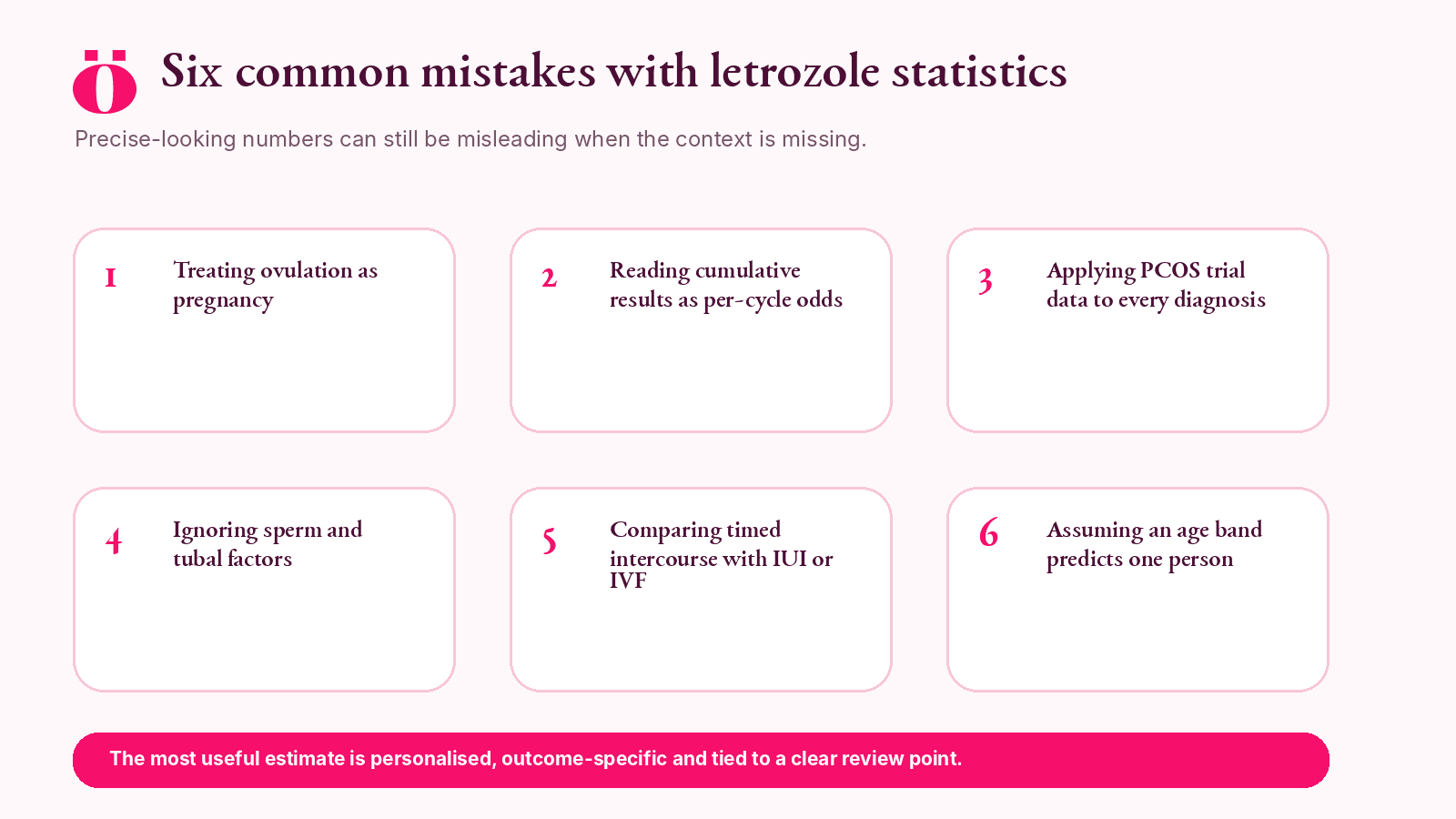
Mistake 1: treating ovulation as pregnancy
Ovulation rates describe whether the ovaries responded. Pregnancy and live birth require several additional steps. Articles that lead with a high ovulation percentage may create an unrealistic impression of the chance of taking home a baby.
Mistake 2: reading cumulative success as a per-cycle rate
The landmark 27.5% letrozole result was measured across up to five PCOS treatment cycles. It does not mean that 27.5% of participants had a live birth in every cycle. Cumulative rates naturally rise as more attempts are included.
Mistake 3: applying PCOS evidence to every diagnosis
Letrozole is best supported for anovulatory PCOS without another major infertility factor. A person with unexplained infertility, endometriosis, blocked tubes or significant sperm problems has a different prognosis even when the medicine and age are the same.
Mistake 4: ignoring the denominator
A rate may be calculated per cycle started, per person randomised, per person who ovulated, per insemination or per embryo transfer. Excluding people who cancelled treatment or did not respond can make a result appear better than the experience of everyone who began treatment.
Mistake 5: comparing different treatment settings
Timed intercourse, IUI and IVF are different pathways. Studies may use different sperm preparation, monitoring, trigger injections, cancellation rules and patient selection. Their percentages should not be compared as though the treatments were identical.
Mistake 6: treating age bands as individual predictions
Age groups are useful for population counselling. They can hide meaningful differences in ovarian reserve, sperm, tubal health, duration of infertility, previous pregnancies and treatment response. Someone at the younger end of a band may also have a different outlook from someone at the older end.
How to recognise a trustworthy fertility claim
Quality check | What good reporting looks like |
|---|---|
Defines the outcome | The article says whether the number refers to ovulation, clinical pregnancy or live birth. |
Names the population | The diagnosis, ages and major inclusion criteria are clear. |
Explains the timeframe | It states whether results are per cycle or cumulative and how many cycles were included. |
Shows the source | The claim links to a guideline, randomised trial or systematic review rather than another blog. |
Acknowledges limits | The article explains why the result may not apply directly to every reader. |
Avoids guarantees | The language supports informed decisions rather than promising an outcome. |
A practical example
Headline claim “Letrozole has a 27.5% success rate.” |
|---|
A more accurate version is: “In a trial of women aged 18-40 with anovulatory PCOS, 27.5% of those assigned to letrozole had a live birth over up to five cycles. The result was cumulative and should not be treated as a universal per-cycle or age-specific probability.”
Questions to ask when you see a percentage online
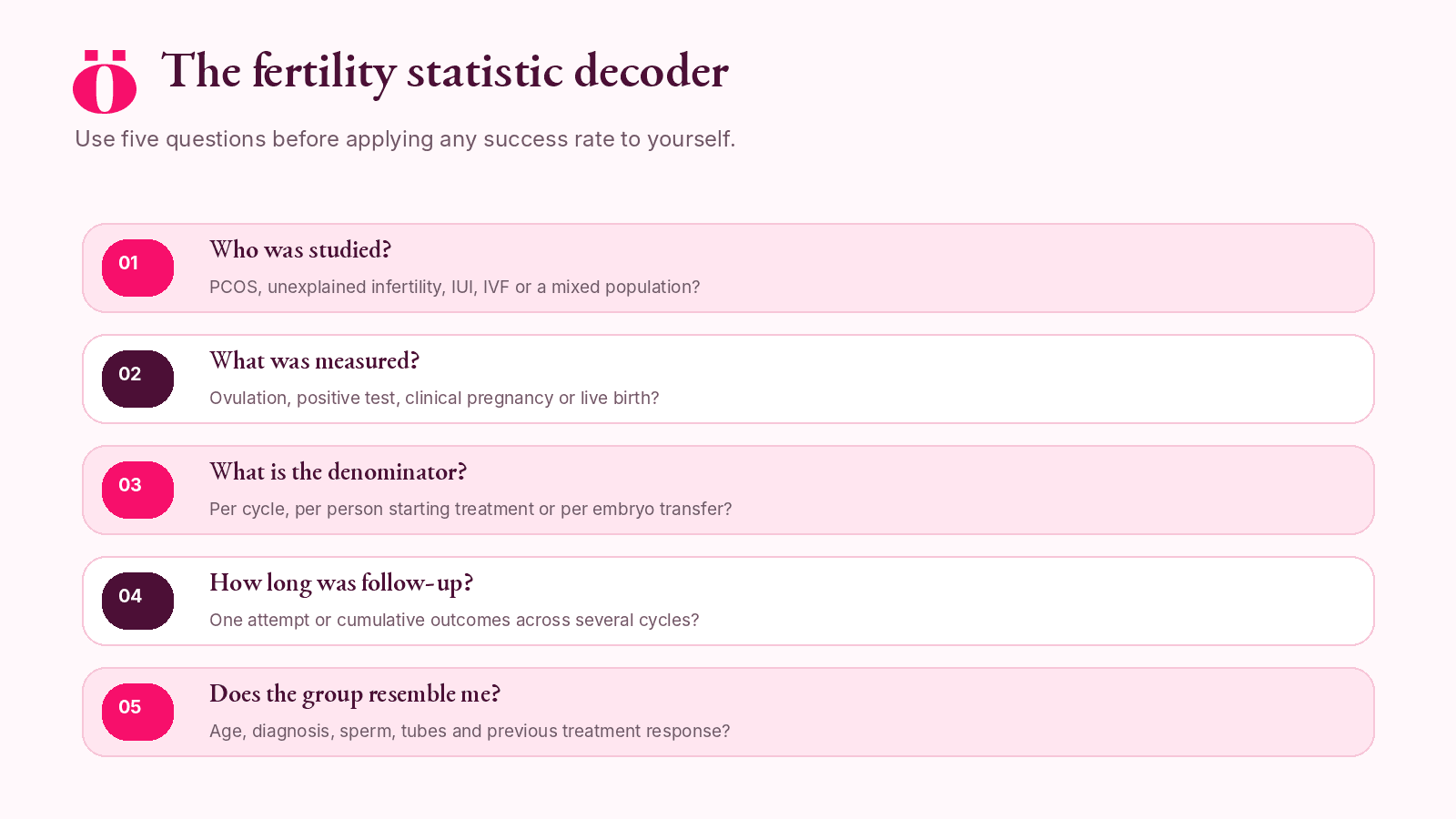
What exactly happened to count as success?
Was the result measured per cycle or over several cycles?
Were all people who started treatment included?
Did participants have PCOS, unexplained infertility or another diagnosis?
Was treatment timed intercourse, IUI or IVF?
How old were participants, and how broad were the age groups?
Is the claim linked to the original source?
What important factors are missing from the headline?
The bottom line
Good fertility information should improve your questions, not replace clinical assessment. Read every percentage as a description of a specific group and outcome. Then ask whether that group, outcome and treatment pathway genuinely resemble yours.
Considering fertility treatment? Start with clarity. Oocyt helps you understand your options, compare clinics and plan your fertility journey locally or internationally. Book a consultation at oocyt.org. |
|---|
References
1. Legro, R.S. et al. (2014) Letrozole versus clomiphene for infertility in the polycystic ovary syndrome. New England Journal of Medicine, 371, 119-129.
2. Franik, S. et al. (2022) Aromatase inhibitors (letrozole) for ovulation induction in infertile women with polycystic ovary syndrome. Cochrane Database of Systematic Reviews, Issue 9.
3. Diamond, M.P. et al. (2015) Letrozole, gonadotropin, or clomiphene for unexplained infertility. New England Journal of Medicine, 373, 1230-1240.
4. NICE (2026) Fertility problems: assessment and treatment. NICE guideline NG257.
Editorial disclaimer Oocyt provides fertility education, guidance and support services only. We do not provide medical advice, diagnosis or treatment. Medical decisions should be made with licensed healthcare professionals and your treating clinic. |
|---|