Treatment Journeys
Amatoritsero Olumami-Oyibo ·
4 min read


Medical information, not personal medical advice Letrozole should only be used under the direction of a qualified fertility clinician. Your age, diagnosis, ovarian response, sperm results, tubal health and treatment setting all affect your individual chance of success. |
|---|
Why age matters in a letrozole cycle
Understanding egg quantity, egg quality and the value of time
Letrozole can help the ovary develop and release an egg. Age influences what happens before and after that response: how many follicles remain available, the likelihood that an egg has the correct number of chromosomes and the chance that a pregnancy continues to live birth.
Reproductive ageing is gradual, not a cliff edge
Fertility does not suddenly disappear on a birthday. Ovarian reserve and egg quality change over time, with wide variation between individuals. Population trends are still useful for counselling because the decline becomes more clinically important in the later thirties and forties.
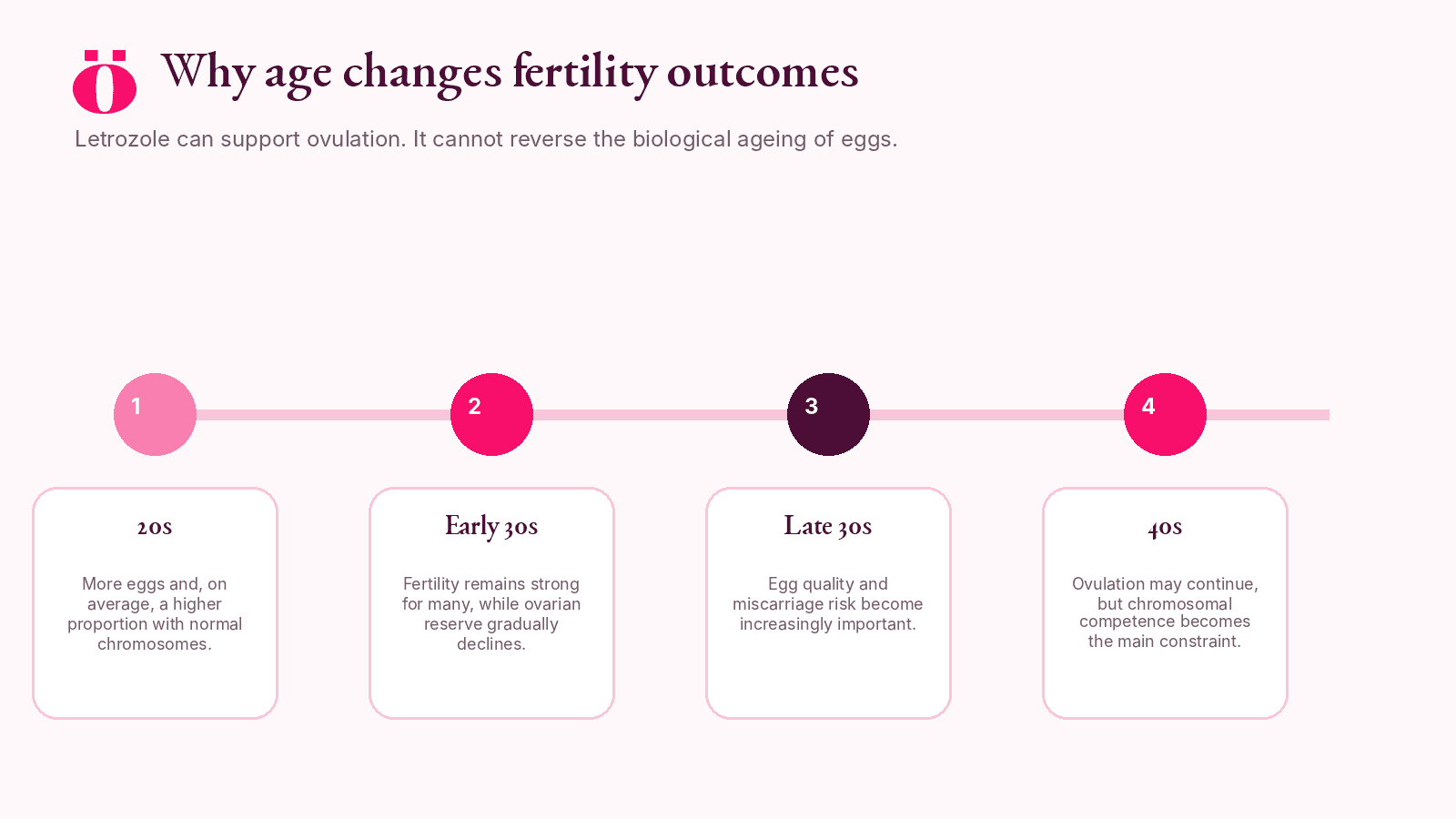
Egg quantity and egg quality are not the same
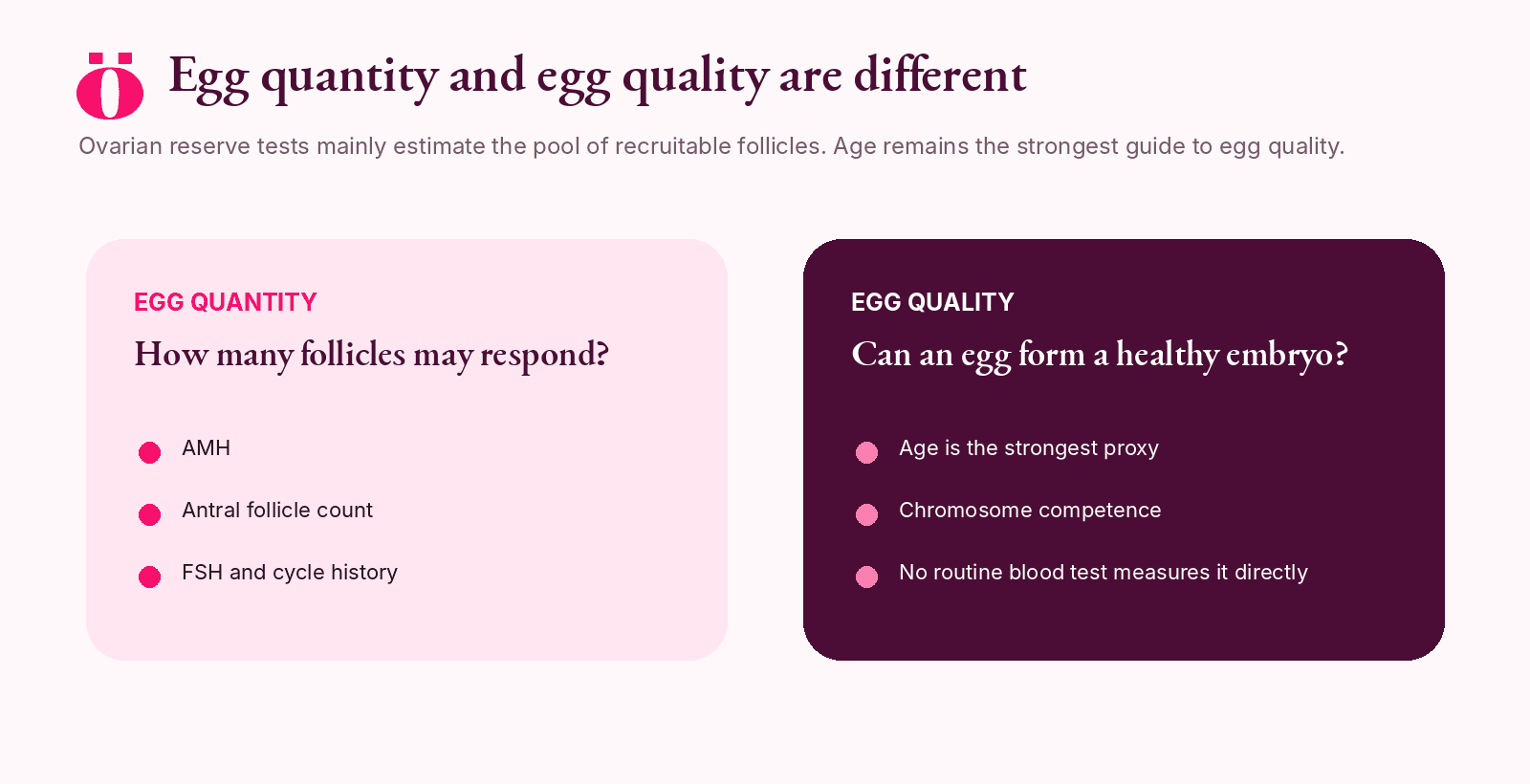
Egg quantity refers to the remaining pool of follicles and the number that may respond to stimulation. Egg quality is shorthand for an egg’s ability to fertilise, develop into a chromosomally competent embryo and support a healthy pregnancy. Age is the strongest available guide to egg quality, but it cannot predict the outcome of one individual egg.
Why chromosome health matters
As eggs age, errors during chromosome separation become more common. An embryo with an abnormal number of chromosomes may fail to implant, result in miscarriage or, less commonly, continue as a pregnancy affected by a chromosome condition. Letrozole changes hormone signalling; it does not correct chromosome errors within an egg.
Why someone can ovulate but not conceive
A mature follicle does not confirm that the released egg is chromosomally competent.
Fertilisation still depends on sperm number, movement, structure and timing.
The fallopian tube must collect the egg and allow sperm and embryo transport.
An embryo must develop for several days before implantation can occur.
Early pregnancy loss becomes more common as chromosome errors increase with age.
How age should change treatment planning
Planning context | What a time-aware approach can look like |
|---|---|
Younger reproductive age | There may be more time to optimise dose, confirm ovulation and try several well-timed cycles when the wider assessment is reassuring. |
Mid-to-late thirties | Set an explicit review point. Consider duration of infertility, ovarian reserve, semen results and whether repeating the same approach remains efficient. |
Forty and over | Discuss the opportunity cost of time early. Ovulation induction may still be reasonable in selected cases, but parallel planning for other options may be appropriate. |
Oocyt clinical insight “Give it more time” is not a neutral recommendation. The value and cost of another cycle depend on age, diagnosis, previous response and the alternatives available. |
|---|
Can lifestyle reverse age-related fertility decline?
Healthy nutrition, movement, sleep, smoking cessation and management of long-term conditions support general and pregnancy health. They may improve ovulation and metabolic health in PCOS. They cannot make eggs biologically younger or guarantee a chromosomally healthy embryo.
Questions to discuss with your clinician
Is my main barrier absent ovulation, or are age and other factors equally important?
How did my ovaries and endometrium respond in the first monitored cycle?
What is the planned maximum number of ovulatory cycles before review?
Would delaying another treatment reduce my overall chance of live birth?
Should investigations or referrals happen in parallel rather than one after another?
The bottom line
Letrozole can improve the chance that ovulation occurs. Age mainly changes the chance that the released egg completes the remaining steps to live birth. A good plan respects both facts at the same time.
References
1. American Society for Reproductive Medicine Patient Education Committee (2023) Does my age affect my fertility? ReproductiveFacts.org.
2. American Society for Reproductive Medicine (2020) Testing and interpreting measures of ovarian reserve: a committee opinion. Fertility and Sterility, 114(6), 1151-1157.
3. NICE (2026) Fertility problems: assessment and treatment. NICE guideline NG257.
4. Teede, H.J. et al. (2023) International evidence-based guideline for the assessment and management of polycystic ovary syndrome.
Editorial disclaimer Oocyt provides fertility education, guidance and support services only. We do not provide medical advice, diagnosis or treatment. Medical decisions should be made with licensed healthcare professionals and your treating clinic. |
|---|