Treatment Journeys
Amatoritsero Olumami-Oyibo ·
4 min read


Medical information, not personal medical advice Letrozole should only be used under the direction of a qualified fertility clinician. Your age, diagnosis, ovarian response, sperm results, tubal health and treatment setting all affect your individual chance of success. |
|---|
Letrozole success rates by age
A realistic interpretation of what the research means for you
The question “What is my chance of success at my age?” is completely understandable. It is also difficult to answer with one reliable percentage. Letrozole studies differ in who was treated, why the medicine was prescribed, whether treatment used timed intercourse or IUI, how many cycles were counted and whether success meant ovulation, pregnancy or live birth.
This does not mean the evidence is useless. It means the evidence should be interpreted carefully and combined with your own fertility assessment.
Start by defining success
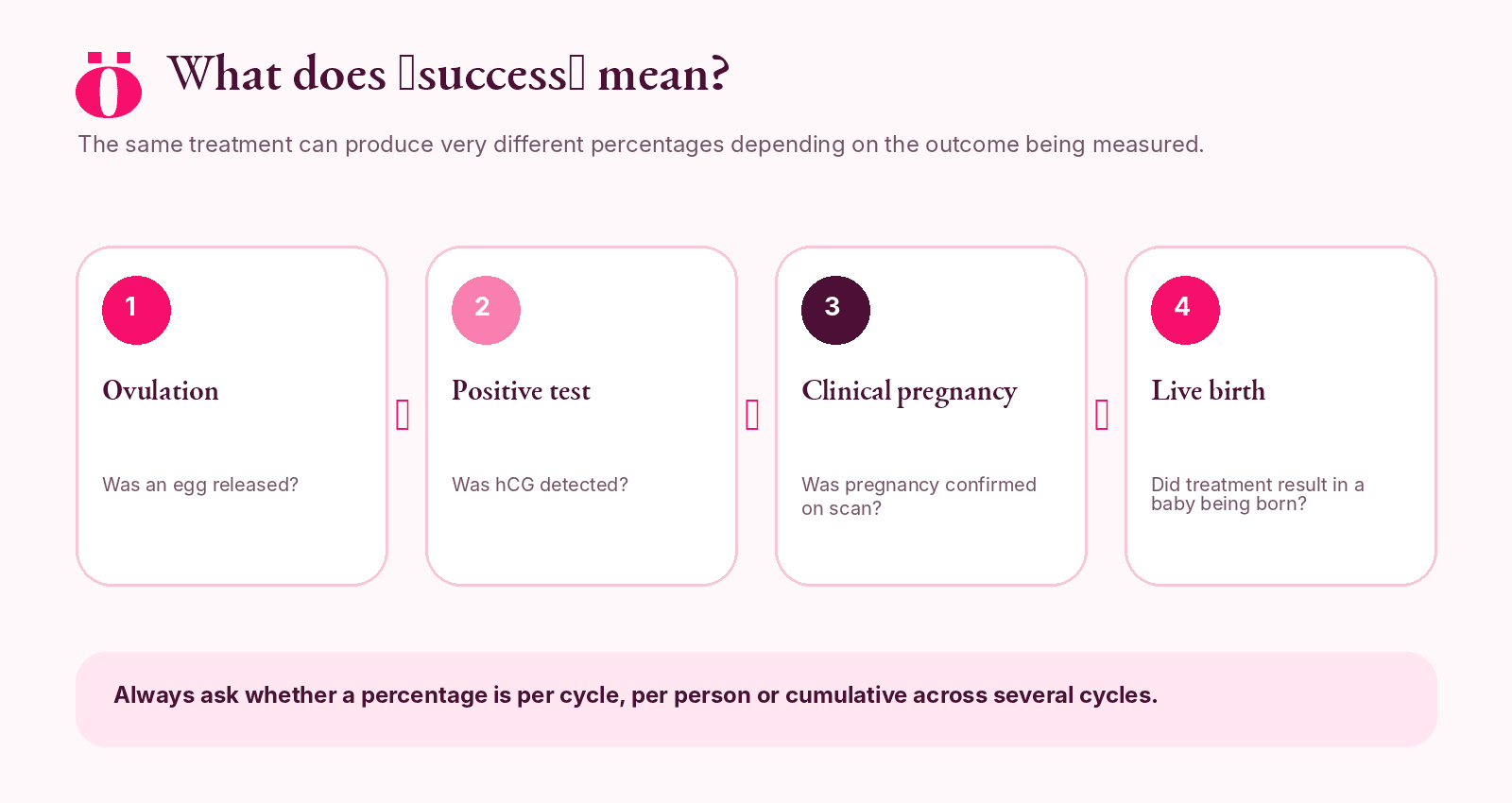
A letrozole “success rate” may describe several different outcomes. The further along the reproductive pathway an outcome occurs, the lower its percentage will usually be.
|
|---|
What the strongest PCOS trial found
In the landmark trial by Legro and colleagues, 750 women aged 18-40 with anovulatory PCOS were assigned to letrozole or clomiphene for up to five treatment cycles. The cumulative live-birth rate was 27.5% with letrozole and 19.1% with clomiphene. Ovulation occurred in 61.7% of letrozole treatment cycles. [1]
The result is important because it shows that letrozole is an effective first-line option for anovulatory PCOS. It should not be re-labelled as a 27.5% chance per cycle, and it should not be applied automatically to people with blocked tubes, significant male-factor infertility, endometriosis or a different diagnosis.
How age changes the interpretation
Age group | How to interpret letrozole outcomes |
|---|---|
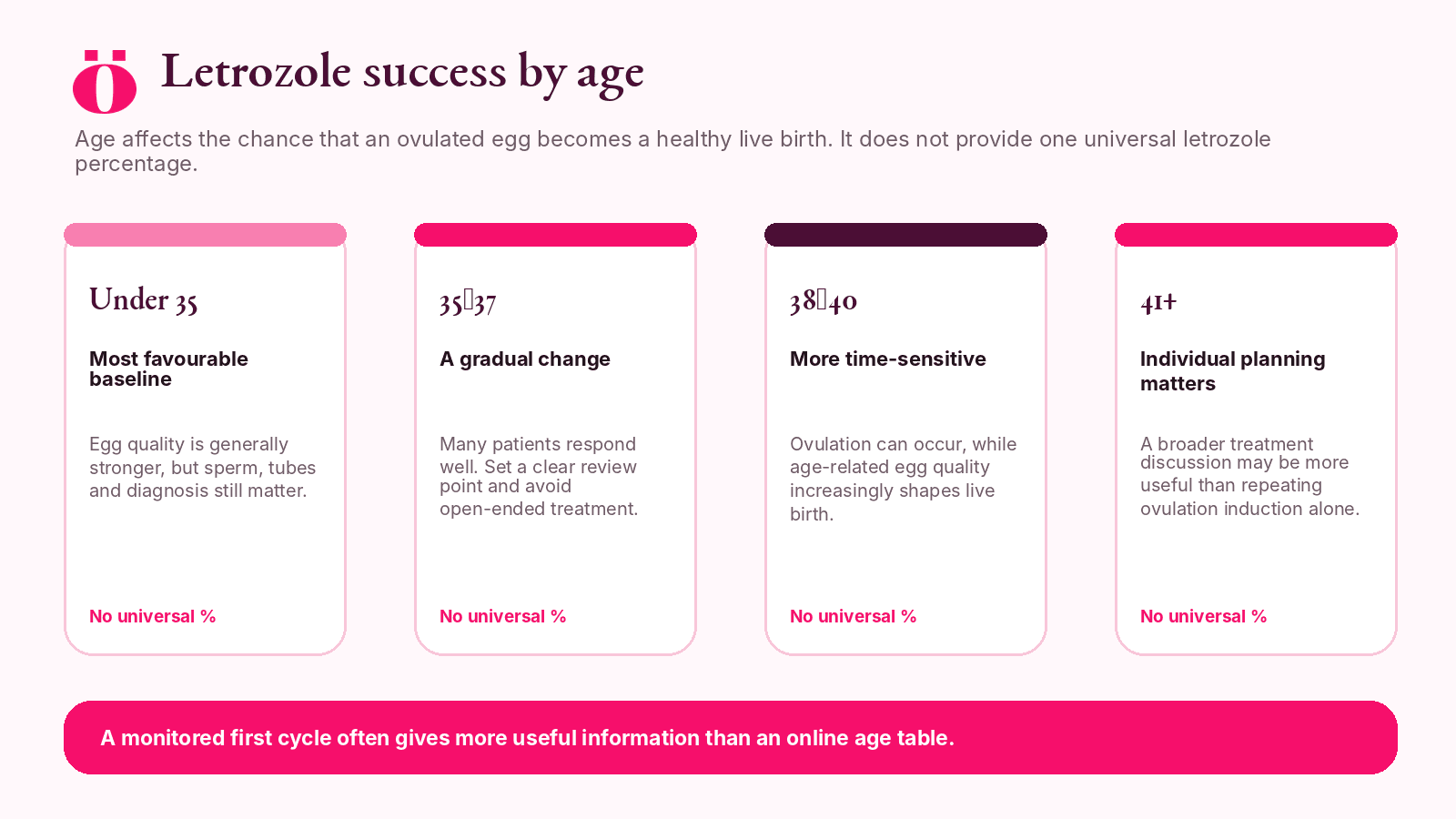
Under 35 | Usually the most favourable reproductive baseline. A good ovulatory response can translate into a reasonable chance of pregnancy when sperm and tubal factors are reassuring. There is still no universal per-cycle percentage. |
35-37 | Many patients continue to respond well to letrozole. Egg quality changes gradually, so treatment should have a clear review point instead of continuing indefinitely. |
38-40 | Letrozole may still produce a mature follicle and ovulation. Age-related egg quality, miscarriage risk and the value of time increasingly shape the wider plan. |
41 and over | Ovulation can occur, but the chance that an ovulated egg produces a chromosomally healthy live birth is lower. A broader discussion about treatment efficiency is especially important. |
What can make two people of the same age have different outcomes?
Whether infertility is mainly caused by absent ovulation or by several factors.
The result of semen analysis and whether sperm treatment is also required.
Whether at least one fallopian tube is open and functioning.
Ovarian reserve and how the ovaries respond in a monitored cycle.
The number and maturity of follicles, and whether treatment is safely timed.
Endometriosis, uterine conditions, previous pelvic infection or surgery.
How long the couple or individual has been trying to conceive.
Whether success is being measured per cycle or cumulatively across a treatment course.
Questions to ask your clinic
What outcome are you quoting: ovulation, clinical pregnancy or live birth?
Is the estimate per cycle or cumulative across several cycles?
Does the evidence come from people with my diagnosis and treatment type?
What did my first monitored cycle reveal about follicle response?
How many well-timed ovulatory cycles will we try before reviewing the plan?
At what point would IUI, IVF or another investigation become more efficient?
|
|---|
The bottom line
Age changes the probability that an ovulated egg becomes a healthy live birth. It does not create one fixed letrozole success rate. The most useful estimate is personalised, linked to a specific outcome and accompanied by a clear review point.
References
1. Legro, R.S. et al. (2014) Letrozole versus clomiphene for infertility in the polycystic ovary syndrome. New England Journal of Medicine, 371, 119-129. https://doi.org/10.1056/NEJMoa1313517
2. Teede, H.J. et al. (2023) Recommendations from the 2023 international evidence-based guideline for the assessment and management of polycystic ovary syndrome. Journal of Clinical Endocrinology & Metabolism, 108(10), 2447-2469.
3. Franik, S. et al. (2022) Aromatase inhibitors (letrozole) for ovulation induction in infertile women with polycystic ovary syndrome. Cochrane Database of Systematic Reviews, Issue 9.
4. NICE (2026) Fertility problems: assessment and treatment. NICE guideline NG257.
Editorial disclaimer Oocyt provides fertility education, guidance and support services only. We do not provide medical advice, diagnosis or treatment. Medical decisions should be made with licensed healthcare professionals and your treating clinic. |
|---|