Treatment Journeys
·
6 min read

Medical information, not personal medical advice Letrozole should only be used under the direction of a qualified fertility clinician. Your diagnosis, age, ovarian response, partner or donor sperm results, tubal health and treatment setting all affect your individual chance of success. |
Letrozole success rates by age
Your complete evidence-based guide to ovulation induction, PCOS and pregnancy
Trying to conceive can be exciting, emotional and sometimes overwhelming. If your fertility specialist has recommended letrozole, you are probably wondering:
Will letrozole help me ovulate?
What are my chances of getting pregnant?
Does my age affect success?
Is letrozole better than Clomid?
How many cycles should I try before considering IVF?
These are some of the most common questions we hear at Oocyt.
The good news is that letrozole has become one of the most effective first-line fertility treatments for women who are not ovulating regularly, particularly those living with polycystic ovary syndrome (PCOS).
However, one important point is often misunderstood.
Many websites quote fixed pregnancy percentages based purely on age. In reality, fertility is far more personal than that.
Your chances of pregnancy depend on several factors working together, including:
Age
Egg quality
Ovarian reserve
Ovulation
Fallopian tubes
Sperm quality
Uterine health
Overall reproductive health
Rather than focusing on one number, understanding the complete picture helps you make informed decisions about your fertility journey.
This guide explains what letrozole does, who it helps, how age influences treatment, what the latest research tells us and how you can maximise your chances of success.
At a glance
Quick fact | What it means |
|---|---|
Medication | Letrozole (Femara®) |
Medication type | Aromatase inhibitor |
Primary purpose | Ovulation induction |
Best-supported use | Anovulatory infertility due to PCOS |
Treatment length | Usually five days each menstrual cycle |
Typical starting dose | 2.5 mg daily, according to the prescribing clinic |
Monitoring | Ultrasound scans and/or hormone blood tests |
Often combined with | Timed intercourse or IUI |
|
Why trust this guide?
The internet is full of articles quoting exact success rates for letrozole. Unfortunately, many figures are taken out of context, use different definitions of success or are based on older studies.
At Oocyt, we believe patients deserve accurate, evidence-based information rather than unrealistic promises. This guide draws on:
The International Evidence-Based Guideline for PCOS (2023)
NICE fertility guidance
The American Society for Reproductive Medicine (ASRM)
The European Society of Human Reproduction and Embryology (ESHRE)
Landmark clinical trials published in the New England Journal of Medicine
Cochrane systematic reviews
Rather than focusing on isolated statistics, we explain what the evidence can and cannot tell you.
Quick answer
Does letrozole really work?
Yes - for the right patient.
Letrozole is considered one of the most effective medications for inducing ovulation in women who do not ovulate regularly, especially those with PCOS.
Research has shown that letrozole can:
Improve ovulation rates
Increase pregnancy rates
Improve live-birth rates
Produce a lower multiple-pregnancy rate than Clomid in women with PCOS
One of the largest fertility studies found that approximately 27.5% of women with PCOS achieved a live birth after up to five letrozole treatment cycles, compared with 19.1% treated with clomiphene (Clomid). This was a cumulative result across several cycles, not a personalised chance per cycle or for a particular age. [2]

How to read this result The 27.5% figure does not mean your chance of pregnancy is exactly 27.5%. It demonstrates that letrozole is effective when prescribed for the right indication and used across a defined course of treatment. |
What is letrozole?
Originally developed to treat hormone-sensitive breast cancer, letrozole is now widely used in fertility medicine because it can help stimulate ovulation.
Although it was not originally licensed specifically for fertility treatment, it is commonly prescribed by fertility specialists around the world and is recommended in international clinical guidance for women with anovulatory PCOS. In UK fertility practice, its use for ovulation induction is generally off-label.
Today, it is considered the first-line ovulation-induction medication for many women with irregular or absent ovulation. [1]
How does letrozole work?
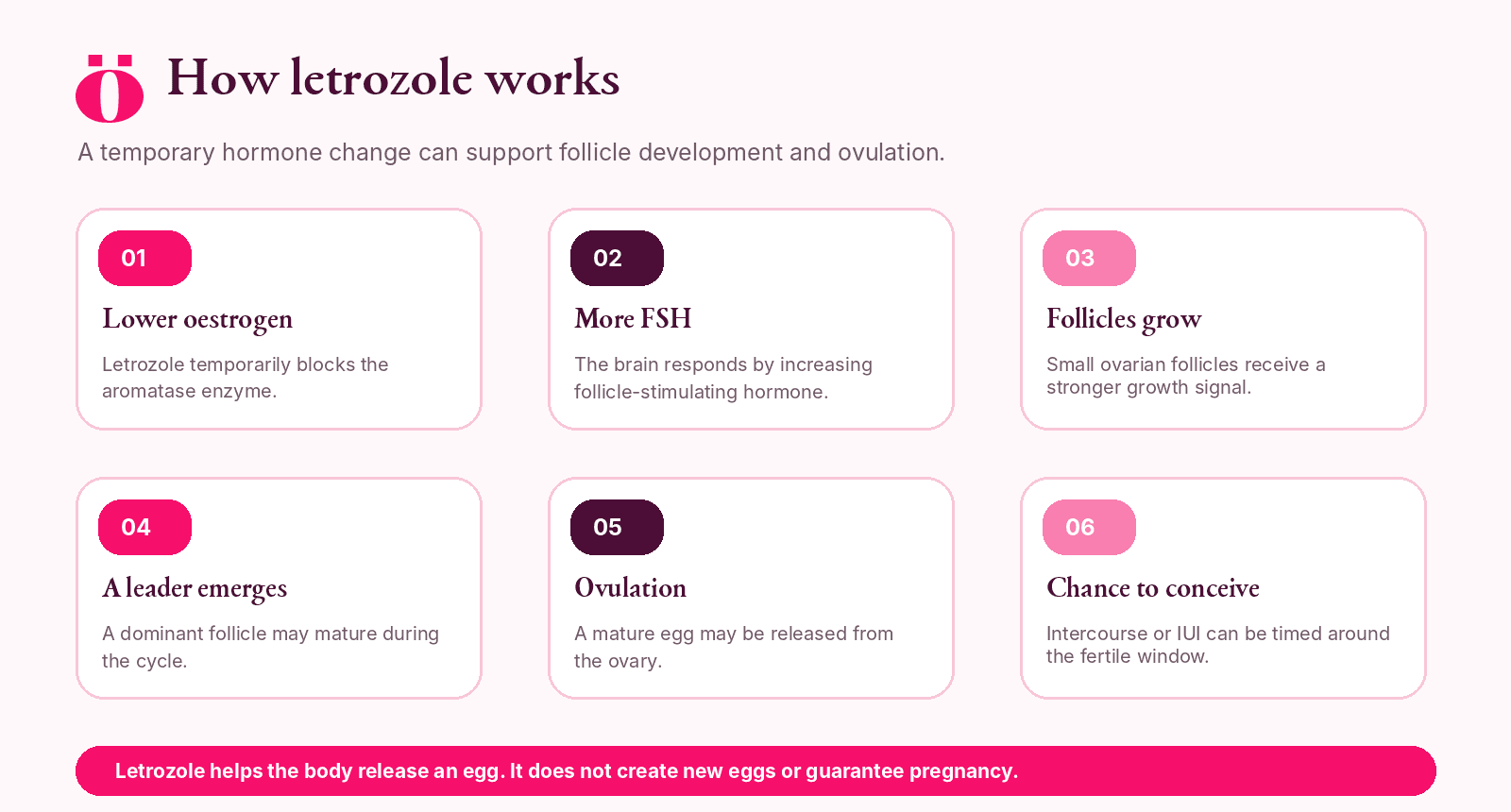
To understand letrozole, it helps to understand how ovulation normally occurs. Each month, the brain communicates with the ovaries using hormones. One of the most important is follicle-stimulating hormone (FSH), which encourages small follicles inside the ovary to grow.
Usually, one follicle becomes dominant and releases an egg during ovulation. Women with PCOS may have many small follicles but struggle to develop one mature follicle capable of releasing an egg.
Letrozole temporarily lowers oestrogen production. The brain detects this reduction and responds by producing more FSH. This stronger signal may help the ovary mature a dominant follicle and increase the chance of ovulation.
|
Who is letrozole most suitable for?
A fertility specialist may recommend letrozole for:
PCOS
Irregular menstrual cycles
Absent ovulation (anovulation)
Infrequent ovulation (oligo-ovulation)
Previous unsuccessful Clomid treatment
Selected cases of unexplained infertility
Ovulation induction before IUI
Other mild ovulatory disorders after assessment
It is not suitable for everyone. People with blocked fallopian tubes, severe male-factor infertility or certain other fertility conditions may benefit from different treatment options, including IVF.
|
Why has letrozole replaced Clomid for many women?
For many years, Clomid (clomiphene citrate) was the standard treatment for ovulation induction. It remains effective, but research over the past decade has shown that letrozole offers important advantages for many women with PCOS.
Letrozole | Clomid |
|---|---|
First-line treatment for anovulatory PCOS | Previously used as first-line treatment |
Higher live-birth rate in the landmark PCOS trial | Lower live-birth rate in the same trial |
Lower twin-pregnancy rate in the trial | A somewhat higher twin-pregnancy rate |
Usually less effect on the uterine lining | May thin the uterine lining in some patients |
Usually less effect on cervical mucus | Can reduce fertile cervical mucus |
Often well tolerated | More anti-oestrogenic effects for some patients |
|
Coming up next
The next sections of this cornerstone guide will cover:
Part 2 | Letrozole success rates by age |
Part 3 | Why age matters |
Part 4 | The role of AMH and ovarian reserve |
Part 5 | Why ovulation does not always lead to pregnancy |
Part 6 | Common mistakes when interpreting fertility statistics |
References
1. Teede, H.J. et al. (2023) Recommendations from the 2023 international evidence-based guideline for the assessment and management of polycystic ovary syndrome. European Journal of Endocrinology, 189(2), G43-G64.
2. Legro, R.S. et al. (2014) Letrozole versus clomiphene for infertility in the polycystic ovary syndrome. New England Journal of Medicine, 371, 119-129.
3. Franik, S. et al. (2022) Aromatase inhibitors (letrozole) for ovulation induction in infertile women with polycystic ovary syndrome. Cochrane Database of Systematic Reviews, Issue 9.
4. NICE (2026) Fertility problems: assessment and treatment. NICE guideline NG257.
5. Cambridge University Hospitals NHS Foundation Trust (accessed July 2026) Using letrozole tablet (Femara®) for ovulation induction.
Editorial disclaimer Oocyt provides fertility education, guidance and support services only. We do not provide medical advice, diagnosis or treatment. Medical decisions should be made with licensed healthcare professionals and your treating clinic. |