Wellbeing
Dr Olaitan Shote ·
13 min read


FERTILITY & EMOTIONAL WELLBEING
Medical information, not personal mental-health advice This guide explains common emotional responses to infertility and fertility treatment. It does not replace assessment by a qualified healthcare or mental-health professional. Seek urgent help immediately if you feel unsafe or are thinking about harming yourself or someone else. |
The quick answer
Infertility can affect far more than the reproductive system. It can influence mood, sleep, confidence, identity, relationships, sex, work, finances, faith and the way someone imagines their future.
Around one in six people of reproductive age experience infertility in their lifetime. The World Health Organisation recognises infertility as a disease of the male or female reproductive system and also highlights its emotional, social and financial consequences. [1,2]
This does not mean everyone with infertility will develop depression or anxiety. It means distress is understandable, support should be offered routinely, and nobody should have to reach breaking point before receiving help.
The most important correction Infertility is medically classified as a disease of the reproductive system. It is not a personal failure, punishment or measure of anyone’s worth. |
Contents
Why infertility can feel like a major life crisis
Common emotional responses
The monthly cycle and treatment rollercoaster
How distress may appear in women and men
Relationships, sex and intimacy
Family, culture, stigma and social pressure
Faith, money, work and identity
Coping after an unsuccessful treatment cycle
When to seek urgent help
How partners and professionals can help
Preparing emotionally for fertility treatment
Questions to ask your clinic
Why can infertility feel like a major life crisis?
Trying to conceive often begins as a private hope. When pregnancy does not happen, that hope can become tied to medical tests, dates, procedures and decisions that feel outside your control.
The loss involved is not always visible. Someone may be grieving a pregnancy that has not happened, the family timeline they expected, confidence in their body, financial security or the belief that parenthood would be straightforward.
Infertility can therefore feel like an ongoing or “ambiguous” loss: there may be no single event to mourn, while hope and uncertainty continue side by side.
What makes the experience difficult Uncertainty, repeated waiting, invasive tests, treatment side effects, difficult decisions and the possibility of disappointing results. | What can make it heavier Stigma, blame, secrecy, family pressure, unequal access to care, previous loss, financial hardship or an unsupportive relationship. |
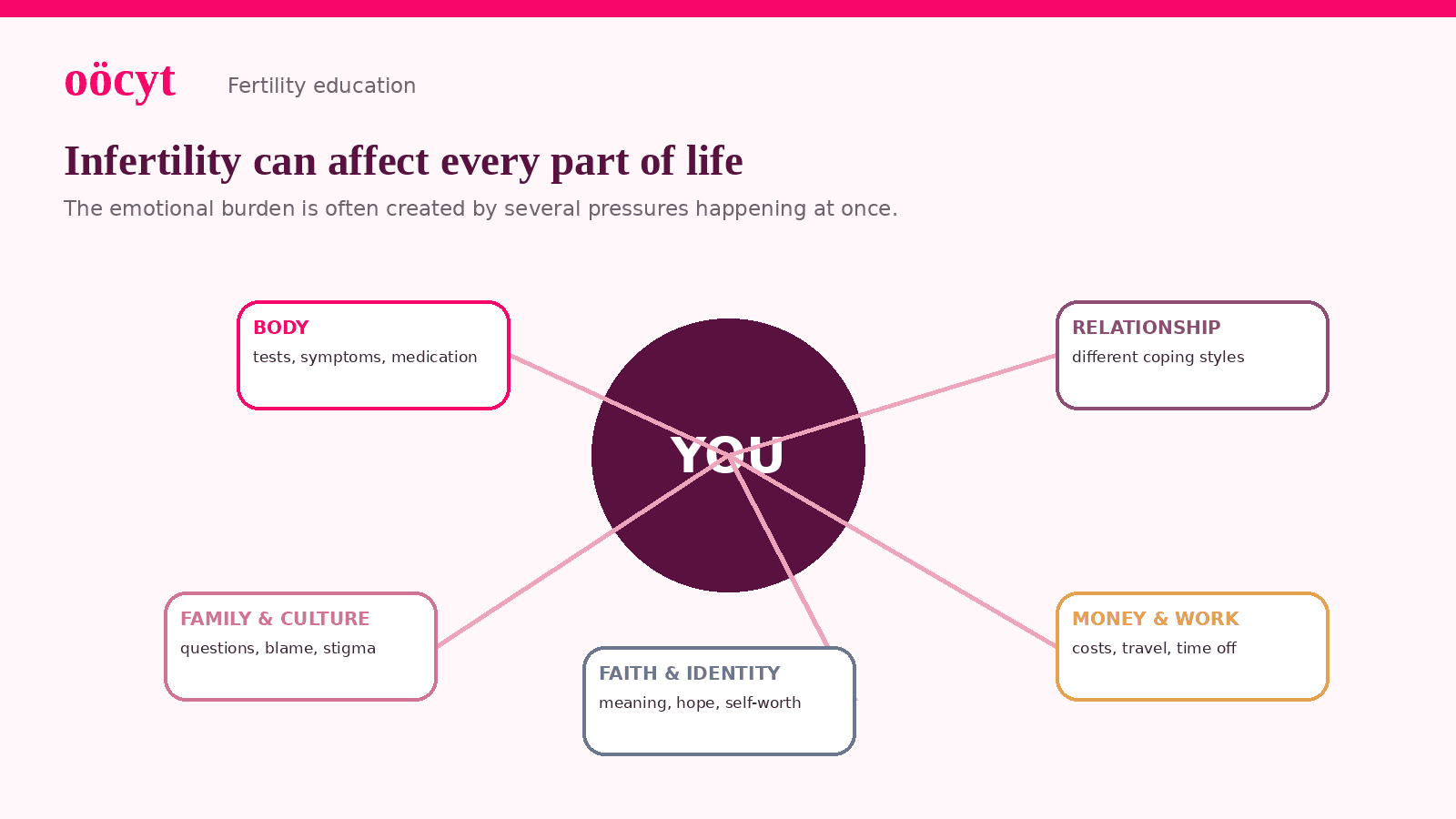
Oocyt perspective Emotional support is not an optional extra added after the medical work. It is part of safe, person-centred fertility care. |
Common emotional responses to infertility
There is no single “normal” response. Feelings can change across the menstrual cycle, after appointments, during treatment or when someone else announces a pregnancy.
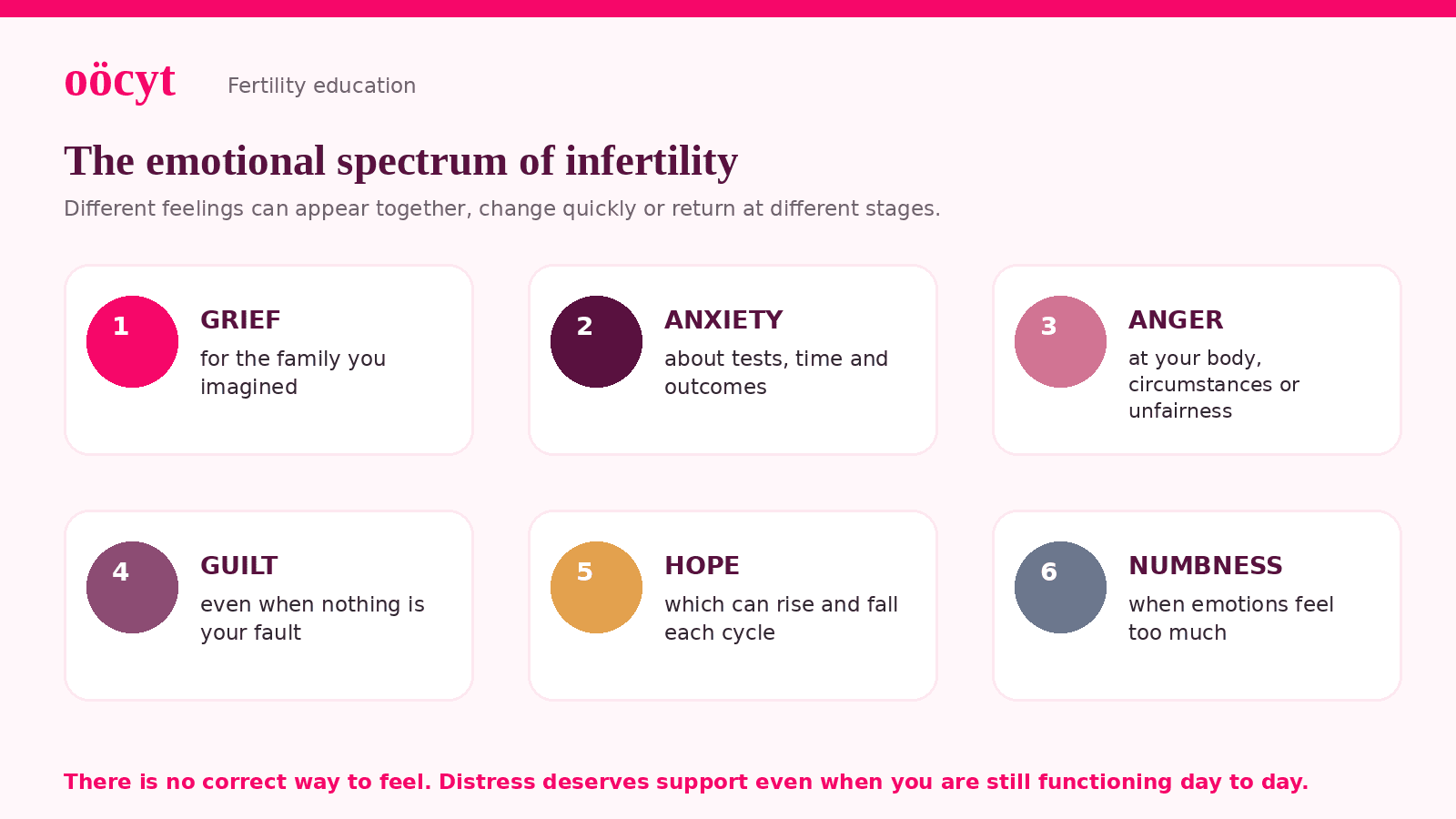
Distress is not the same as weakness
Some people continue working, caring for others and attending appointments while feeling deeply distressed. Others may struggle to function. Both experiences deserve attention.
Research consistently finds elevated stress, anxiety and depressive symptoms among people experiencing infertility. Women often report greater distress in studies, but men can also experience substantial psychological strain, particularly after a diagnosis of male factor infertility. [6,7]
A note about language Try to avoid telling someone to “just relax”, “stop thinking about it” or “be grateful”. These phrases can minimise a complex medical and emotional experience. |
The monthly cycle and treatment rollercoaster
Fertility care can create repeated peaks and crashes. A new cycle may bring hope. Tests and procedures can increase anxiety. The waiting period may make every physical sensation feel significant. A negative result can then restart the process.
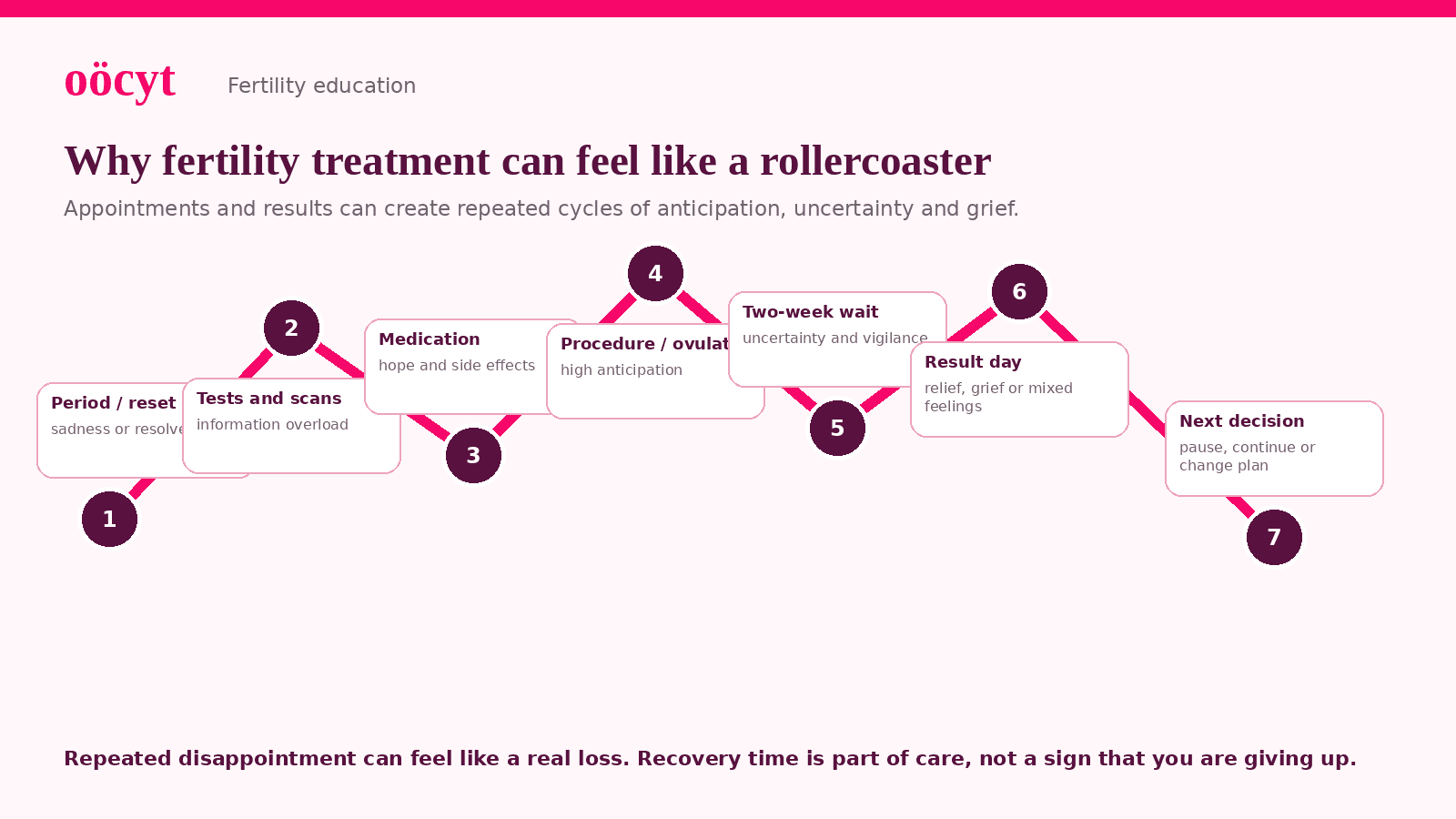
After an unsuccessful cycle
An unsuccessful cycle can feel like bereavement. There may be grief for the embryo, pregnancy or future that had already become emotionally real. HFEA guidance encourages people to allow recovery time and seek support after treatment does not work. [8]
Ask for a clear medical review rather than immediately blaming yourself.
Allow time before making major decisions when emotions are intense.
Discuss what information you want about the next step — and what can wait.
Plan who will know the result and how you want them to respond.
Consider counselling even if you intend to continue treatment quickly.
It is acceptable to pause A pause can be used for emotional recovery, financial planning, further medical review or simply to live outside treatment for a while. Pausing does not erase your commitment to parenthood. |
Women, men and different ways distress can appear
Infertility can affect anyone, regardless of which partner has the identified fertility factor. However, cultural expectations often place greater blame and scrutiny on women, even when infertility is male factor, combined or unexplained. WHO identifies stigma, divorce, violence, depression, anxiety and low self-esteem among the social consequences experienced particularly by women in some settings. [1]
Men may be expected to remain practical or emotionally contained. Some experience shame, isolation, reduced confidence or fear that a diagnosis reflects their masculinity. These feelings may be hidden rather than absent.
Distress may look more visible Crying, panic, repeated reassurance-seeking, irritability, difficulty sleeping, withdrawing from social events or feeling unable to think about anything else. | Distress may look more hidden Working longer hours, avoiding appointments, refusing to discuss treatment, using humour, becoming unusually quiet, drinking more or focusing only on facts and solutions. |
Do not compare pain One partner’s reaction should not be used to measure the other’s commitment. Different coping styles can exist in the same relationship. | |
Relationships, sex and intimacy
Infertility can bring couples closer, create distance or do both at different times. Conflict often grows when partners need different things: one may want to talk repeatedly while the other needs quiet, distraction or action.
Sex can also become scheduled, observed or linked to performance. Timed intercourse, tests and treatment can reduce spontaneity and make intimacy feel like a task. Desire may fall because of stress, medication, pain, body-image changes or fear of another disappointment.
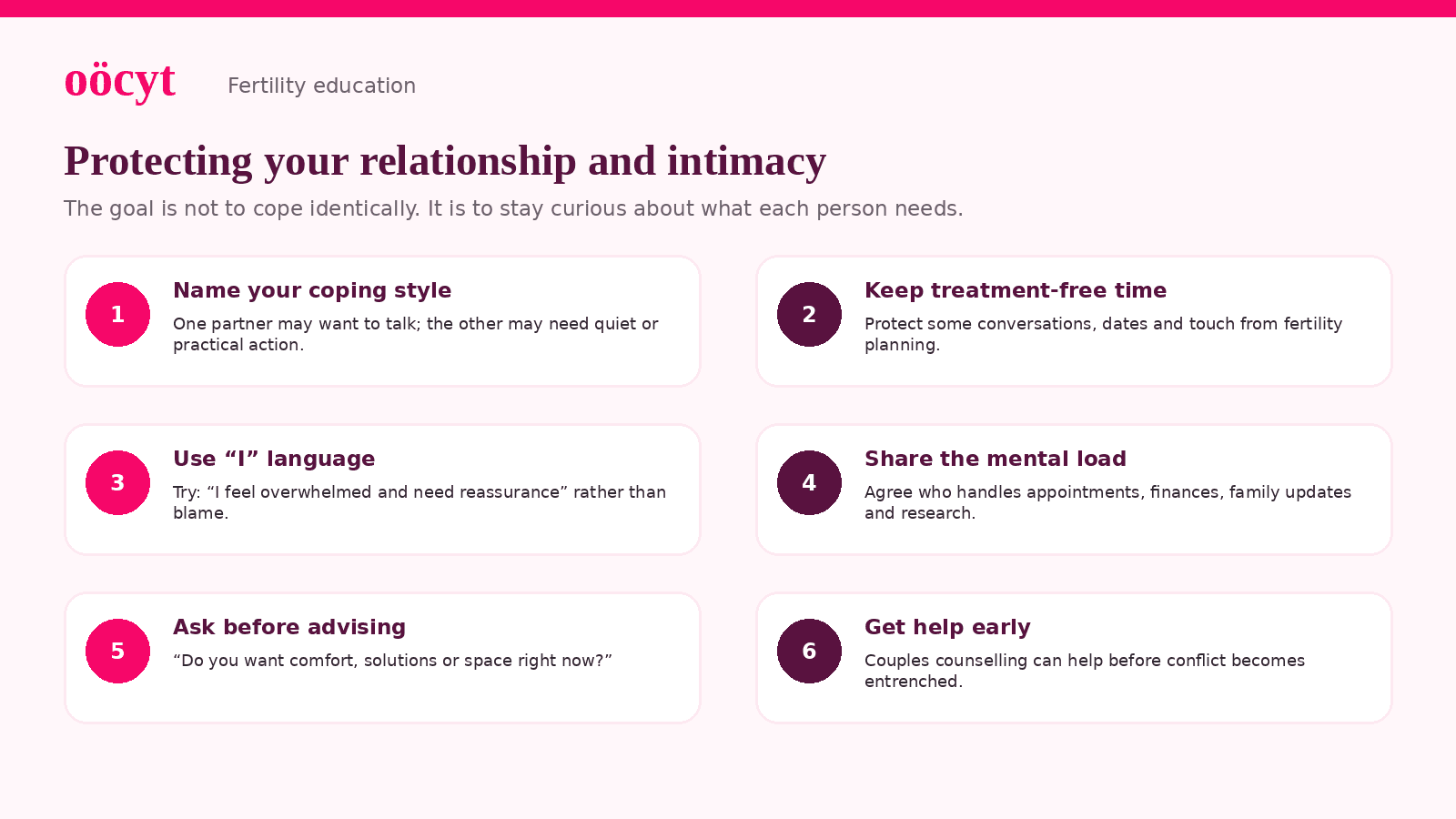
A simple weekly check-in
What felt hardest this week?
What helped, even slightly?
Do you need comfort, practical help or space?
What fertility-free activity can we protect this week?
Is there anything we are avoiding that needs professional support?
Family, culture and social pressure
Questions such as “When are you having children?” may seem harmless to the person asking, but can feel painful, intrusive or humiliating. In communities where parenthood carries strong social status, infertility may expose people to blame, gossip, pressure to pursue unsafe treatment or threats to a relationship.
Women may be blamed automatically. Men may resist testing because of stigma. Couples may spend energy protecting themselves from relatives at the same time as managing treatment.
Boundaries you are allowed to use
“We are dealing with a private medical matter and will share updates when we are ready.”
“Please do not ask us about pregnancy unless we bring it up.”
“We appreciate your concern, but advice about herbs, clinics or spiritual causes is not helpful right now.”
“We will not discuss whose fertility factor is involved.”
“We are taking a break from baby-related events and will reconnect when we can.”
Safety matters If infertility is being used to justify violence, coercion, threats, financial control or forced treatment, tell a trusted professional and seek safeguarding support. Abuse is never an acceptable response to infertility. |
Faith, spirituality and meaning
Faith can provide comfort, community and hope. It can also become complicated when prayers appear unanswered, people suggest that infertility reflects weak faith, or religious advice conflicts with medical care.
It is possible to seek spiritual support and evidence-based fertility treatment at the same time. A supportive faith leader should respect privacy, avoid blame and understand that medical decisions belong to the patient and clinical team.
Faith may support coping Prayer, reflection, community, meaning, rituals of hope and connection to values. | Faith may become painful Feeling abandoned, being blamed, pressure to disclose, promises of guaranteed pregnancy or being advised to stop appropriate medical treatment. |
Choose support that feels safe You are allowed to step away from conversations, groups or religious spaces that intensify shame or pressure. | |
Money, work and access to care
Fertility investigation and treatment can involve consultation fees, medicines, tests, travel, accommodation and time away from work. WHO reports that fertility care is frequently paid for out of pocket and can create severe financial hardship. [2]
Financial stress can affect treatment decisions and relationships. People may feel guilty about spending, fear running out of money or continue treatment because stopping feels like wasting what has already been invested.
Questions to discuss before committing financially
What is included in the quoted price — and what is not?
Which costs are likely to repeat if the cycle is unsuccessful?
Are medicines, freezing, storage, anaesthesia and laboratory procedures included?
What refund or cancellation terms apply?
What is the agreed financial limit or review point?
How will appointments affect work, caring responsibilities and travel?
Financial boundaries are clinical boundaries too A treatment plan should be medically appropriate and financially transparent. Pressure to pay immediately or buy unproven add-ons is a reason to pause and ask questions. |
When emotional distress needs urgent help
Sadness and anxiety are common, but certain signs need immediate assessment. Do not wait for a routine fertility appointment when safety is at risk.
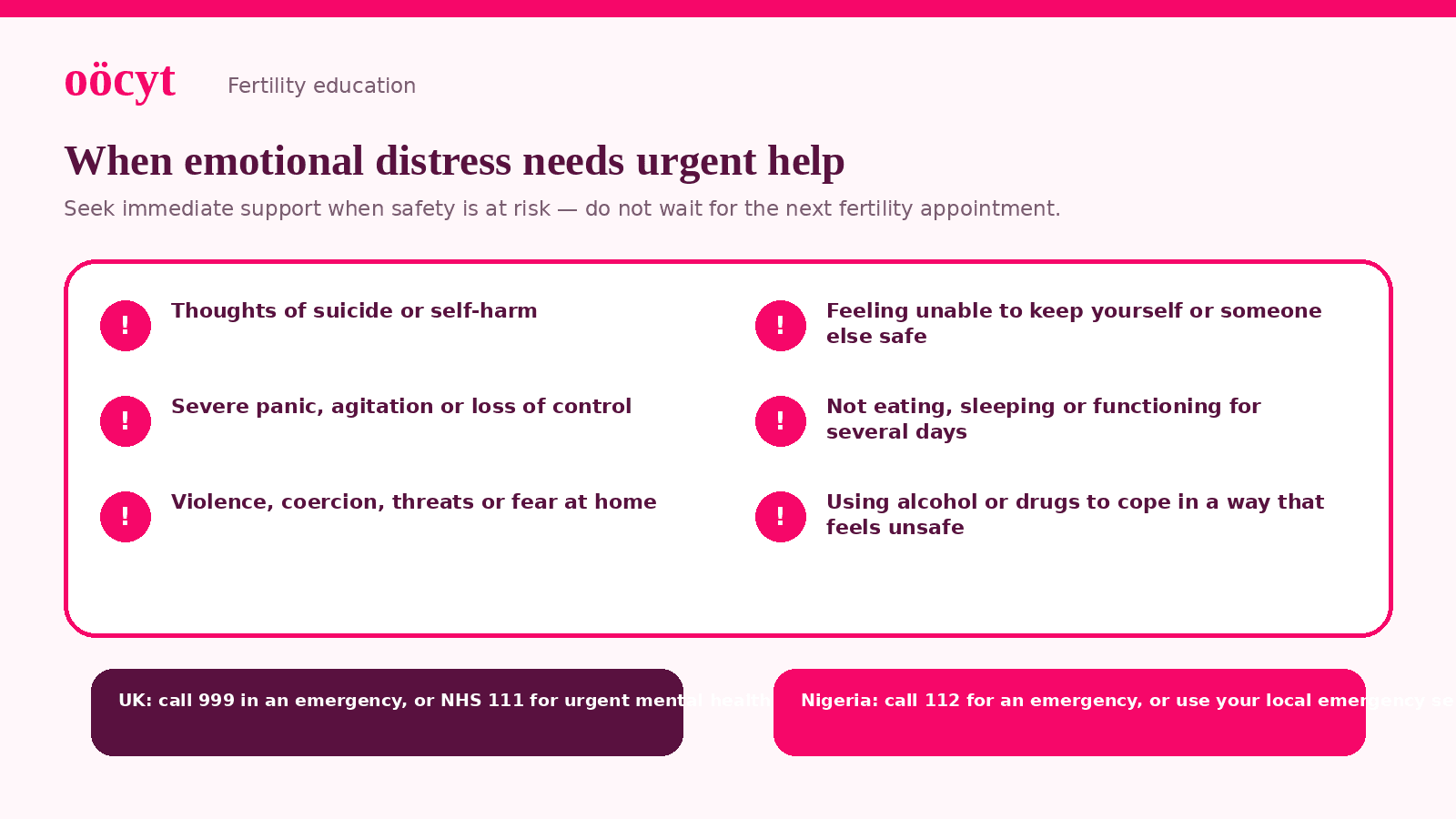
Immediate danger Call emergency services or go to the nearest emergency department. In the UK, call 999; for urgent mental-health advice call NHS 111 and select the mental-health option. In Nigeria, call 112 or your local emergency service. [10,11] |
Arrange a prompt professional review if
Low mood, anxiety or panic is persistent or worsening.
Sleep, appetite or concentration has been significantly affected.
You are missing work, appointments or normal responsibilities.
Conflict, isolation, alcohol or drug use is increasing.
You feel unable to make treatment decisions because of distress.
Past trauma, pregnancy loss or a previous mental-health condition is returning.
How partners and loved ones can help
Support is most useful when it follows the person’s needs rather than the supporter’s urge to fix the situation.
Helpful responses
“I believe you. This is hard.”
“Would you like me to listen, help with a task or give you space?”
“You do not have to protect me from how you feel.”
“We can ask the clinic to explain that again.”
“I will not share your medical information without permission.”
Responses to avoid
“At least you can try IVF.”
“Everything happens for a reason.”
“You are stressing too much.”
“Maybe it is not meant to be.”
Unrequested success stories, miracle cures or comparisons.
Support for the supporter Partners and close family members may also need counselling or a separate space to talk. Supporting someone does not require suppressing your own feelings. |
How fertility professionals can help
Good psychosocial care is not limited to formal therapy. It includes clear information, empathic communication, continuity, realistic expectations, privacy, shared decision-making and referral when additional support is needed. ESHRE guidance recommends incorporating psychosocial care throughout the fertility pathway. [5]
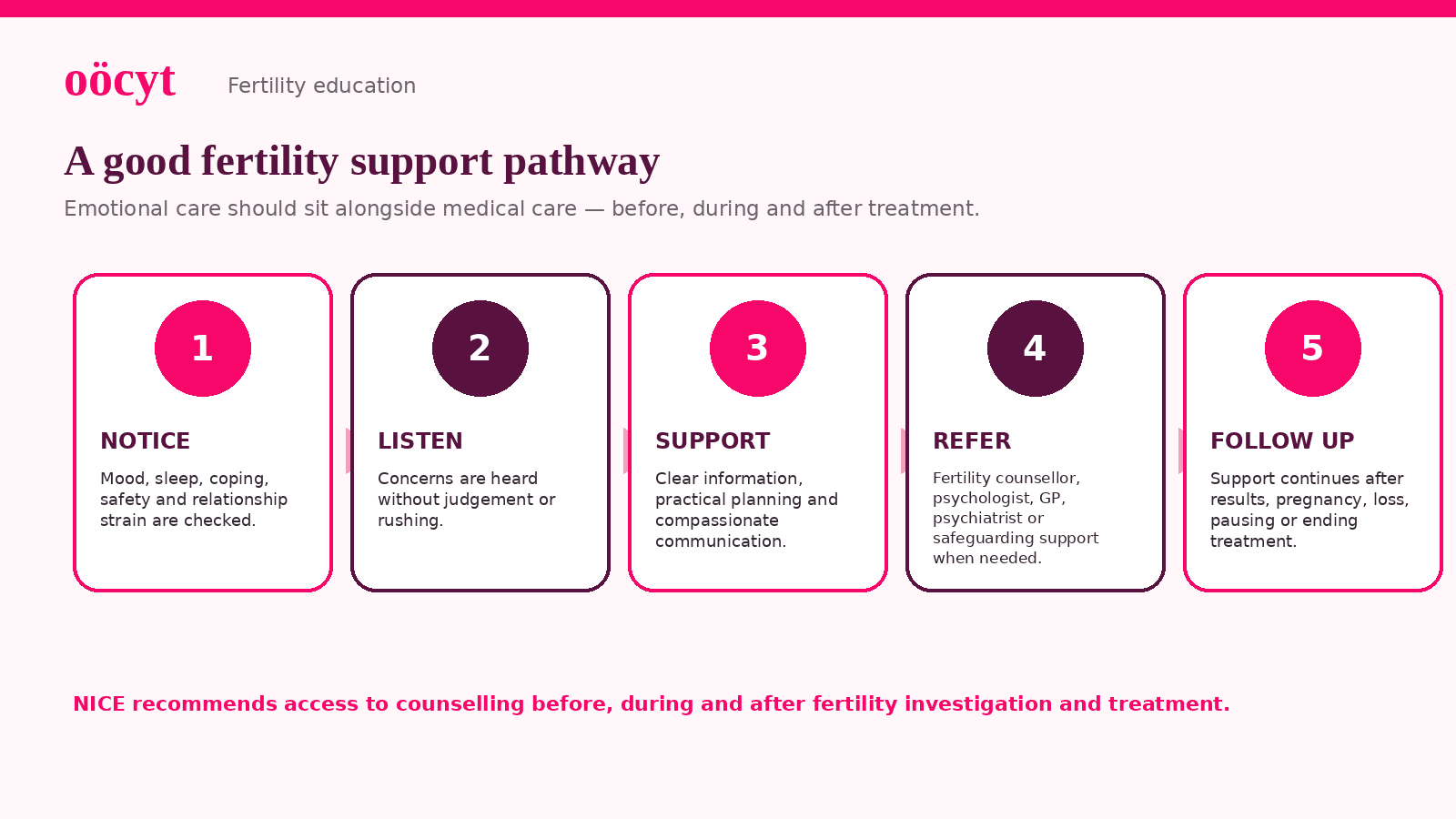
What counselling can offer
A confidential place to process grief, fear, anger or uncertainty.
Support with treatment decisions, donor conception, fertility preservation or ending treatment.
Strategies for anxiety, sleep, communication and difficult social situations.
Couples work when coping styles or intimacy have become strained.
Support after miscarriage, unsuccessful treatment, pregnancy or choosing a different family-building path.
NICE recommends that people experiencing fertility problems are offered counselling before, during and after investigation and treatment. [3,4]
Oocyt clinical insight
 | “You do not need to wait until you are at breaking point before asking for emotional support.” A fertility consultation should make room for the whole person not only test results, medication and procedures. Tell your team when sleep, mood, intimacy, work, finances or relationships are becoming difficult. This information can change how care is planned and what support is offered. Dr Olaitan Shote – Fertility specialist |
Preparing emotionally for fertility treatment
Choose who will know about treatment and what updates they will receive.
Agree how you and your partner will handle results day.
Identify one person outside the relationship who can provide support.
Ask the clinic how to access counselling and urgent advice.
Discuss likely costs and a review point before treatment begins.
Plan treatment-free time and activities that protect your identity beyond fertility.
Questions to ask your fertility clinic
What emotional-support or counselling services are available?
Can I access support before treatment starts, during treatment and after results?
Is the counsellor trained in fertility and reproductive loss?
How will the team respond if I become very distressed during treatment?
Can my partner attend counselling or access separate support?
Who do I contact outside clinic hours?
How are unsuccessful cycles reviewed?
Can I pause treatment without losing my place or stored material?
How will my privacy and medical information be protected?
What support is available for donor conception, fertility preservation or ending treatment?
A clinic should not dismiss emotional concerns You deserve clear information and respectful support. If you feel rushed, blamed, pressured or unable to ask questions, it is reasonable to seek another opinion. |
The bottom line
Infertility is a reproductive-health condition with emotional, relational, social and financial consequences. Feeling distressed does not mean you are coping badly. It means something important, uncertain and demanding is happening.
The right support cannot guarantee a treatment result, but it can help you feel safer, communicate more clearly, make informed decisions and protect your wellbeing throughout the journey.
You are more than a fertility diagnosis Your worth is not measured by a pregnancy test, treatment outcome or ability to have a biological child. |
Considering fertility care? Start with support.
Oocyt helps individuals and couples understand their fertility options, compare clinics and plan treatment locally or internationally. We can also help you identify the questions to ask before committing to a treatment pathway.
Talk to Oocyt WhatsApp +234 803 686 0626 • www.oocyt.org Compassionate guidance. Clear options. Support at every step. |
References
1. World Health Organization (2025). Infertility: fact sheet. https://www.who.int/news-room/fact-sheets/detail/infertility
2. World Health Organization (2025). WHO issues first global guideline on infertility. https://www.who.int/news/item/28-11-2025-who-issues-first-global-guideline-on-infertility
3. National Institute for Health and Care Excellence (2026). Fertility problems: assessment and treatment. NICE guideline NG257. https://www.nice.org.uk/guidance/ng257
4. National Institute for Health and Care Excellence (updated 2026). Fertility problems quality standard QS73: counselling. https://www.nice.org.uk/guidance/qs73
5. European Society of Human Reproduction and Embryology (2015). Routine psychosocial care in infertility and medically assisted reproduction. https://www.eshre.eu/guidelines-and-legal/guidelines/psychosocial-care-guideline.aspx
6. Almutawa, Y.M. et al. (2023). A systematic review and meta-analysis of psychiatric disorders and quality of life among infertile men and women. PubMed PMID: 37181965.
7. Biggs, S.N. et al. (2024). Psychological consequences of a diagnosis of infertility in men: systematic review and meta-analysis. PubMed PMID: 37695221.
8. Human Fertilisation and Embryology Authority. Getting emotional support; Coping if treatment does not work. https://www.hfea.gov.uk/treatments/explore-all-treatments/getting-emotional-support/
9. Gameiro, S. et al. (2012). Why do patients discontinue fertility treatment? Human Reproduction Update, 18(6), 652-669. doi:10.1093/humupd/dms031.
10. NHS. Where to get urgent help for mental health. https://www.nhs.uk/nhs-services/mental-health-services/where-to-get-urgent-help-for-mental-health/
11. Nigerian Communications Commission. Emergency Communications Centres and national emergency number 112. https://ncc.gov.ng/node/3132
Editorial disclaimer: Oocyt provides fertility education, guidance and support services only. We do not provide emergency mental-health care, diagnosis or psychotherapy. Medical and mental-health decisions should be made with appropriately qualified professionals.